MIT App Developer Program

In order to survive in the 21st century, one needs to have an aptitude for technology and software. Interest in software development and application should be encouraged not only by schools but by students themselves. Even professionals in different fields of work, such as law, medicine, finance etc. could have a taste for software development but never got the chance to build on it. Luckily enough, the researchers at the Massachusetts Institute of Technology did not only recognise this but also took steps in order to meet the needs of school-going kids and counter the drawback faced by professionals.

The ‘MIT App Developer Program’ is a cloud-based tool, which means you can make apps right in your web-browser. It is a blocks-based programming tool that allows everyone to build a fully-functional android app in less than an hour. All one needs to get on the Developer bandwagon is a Google account and an android device to experiment with. This paraphernalia is easily available and is also economically viable. Connecting your device and getting started with the development of apps is not a hefty task, thanks to their clearly laid out instructions in the ‘Getting Started’ guide. 

This program was the brain child of Google's Mark Friedman and MIT professor Hal Abelson. It runs as a web service run by staff at the MIT Centre for Mobile Learning. It supports a worldwide community of 3 million users, and more than 100 thousand of its weekly users have built more than 7 million functional apps till date. 

Who uses this program?

This program has encapsulated the attention of a wide variety of people, ranging from formal and informal educators to government and civic employees; from researchers to hobbyists and entrepreneurs.

This Program has bridged the divide between ‘professionals’ and ‘novices’. Children at the age of 14 years can now make android apps without going into the intricacies of Java or PHP. People over the age of 60 with a penchant for programming can sit at home and indulge themselves. This app does not discriminate. 


Working:

The program works in two folds: first, the real time app simulator on your android device which can be downloaded from the Play Store and second, the MIT App Inventor 2 Beta version on your laptop/PC. 

The App inventor consists of the 'Design' and 'Blocks' pages which take care of the front end and back end execution of the apps under construction respectively. The aesthetic aspect of the apps is taken care of using the Design page, while each button or canvas on the design page is given its required functionality with the help of the blocks.
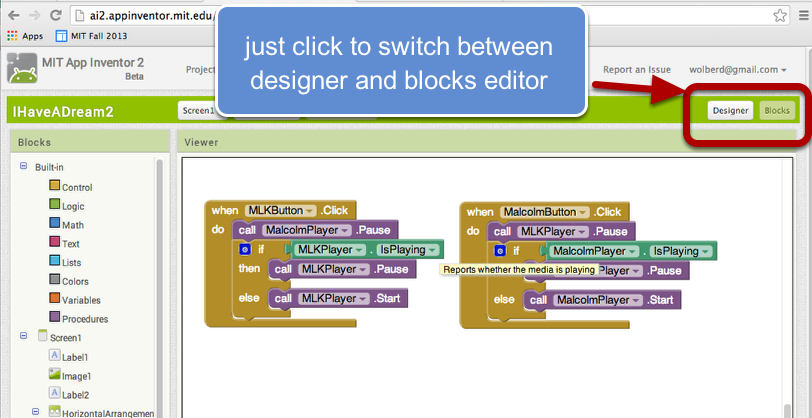

Without having to go into the nuances of Java or any other language, one can easily build functional apps and test them out in real time.

No other technical paraphernalia is required to connect your android device to the laptop. You just need to ensure that both of these are connected to the same WiFi network. How much easier can it really get?

Advantages:

Imagine building an android app at the age of 15 which makes your phone talk at the touch of a button, or bouncing a ball around on the phone screen with your finger. Achieving all this without going into detailed theory does not only boost one’s morale, but also does wonders to expand your horizons.

Venturing into the field of operative app development at a young age can only have a positive impact on one's intellectual growth. Backed by the expertise of Google and MIT, one can be sure that it won't lack in terms research, education and potential for further growth.

One can start building apps according to their own needs without having to depend on other professionals programmers. For instance, a lawyer may need an app which arranges his/her appointments based on certain exclusive requirements, which no other existing app provides. The lawyer can thus make his/her own app just the way he/she wants. 

The myriad of opportunities available to people these days should be exploited to the best of their potential and the skills enhanced should be encouraged and practised by students and professionals alike.

0 comments:

About-Us

03:26 0 Comments

CodeBenders is the programming club of IGDTUW. We aim at providing a platform for competitive programming under CodeChef.

You can join our Facebook group to hold discussions or get help with any coding problem.
https://www.facebook.com/groups/igdtuwCodeChef/

Follow us on twitter https://twitter.com/codebenders

Follow us on Facebook  https://www.facebook.com/CodeBenders

You can also reach us on igdtuwcodebenders@gmail.com

0 comments:

The Sony Hack

The Sony Hack: who did it?

The Sony Pictures Entertainment cyber hack was a release of confidential data belonging to Sony Pictures Entertainment on November 24, 2014.At Sony Pictures Entertainment’s headquarters in Culver City, a typical week begins. The first sign of a digital break-in comes early that morning, when the image of a stylised skull with long skeletal fingers flashes on every employee’s computer screen at the same time, accompanied by a threatening message warning that “This is just the beginning.” The hackers say “we've obtained all your internal data,” and warn that if Sony doesn't “obey” their demands, they will release the company’s “top secrets.”States intelligence officials, evaluating the software, techniques, and network sources used in the hack, allege that the attack was sponsored by North Korea. North Korea has denied all responsibility, and some cyber security experts have cast doubt on the evidence, alternatively proposing that current or former Sony Pictures employees may have been involved in the hack.


The data included personal information about Sony Pictures employees and their families, e-mails between employees, information about executive salaries at the company, copies of unreleased Sony films, and other information.
The hackers called themselves the "Guardians of Peace" or "GOP" and demanded the cancellation of the planned release of the film The Interview, a comedy about a plot to assassinate North Korean leader Kim Jong-un


North Korea, at the centre of a confrontation with the United States over the hacking of Sony pictures, itself experienced Internet outages on 22 December 2014, Monday, a U.S. company that monitors Internet infrastructure said.It's not clear if the Internet connectivity problems were an act of retribution for a major intrusion at Sony Pictures Entertainment that the FBI linked to North Korea.

Washington requested China's help, asking Beijing to shut down servers and routers used by North Korea that run through Chinese networks, senior administration officials told Reuters. But China had not responded directly to the U.S. requests, the officials added.
In Beijing, the Chinese Foreign Ministry said that it opposed all forms of cyber attacks and that there was no proof that North Korea was responsible for the Sony hacking.
China is North Korea's only major ally and would be central to any U.S. efforts to crack down on the isolated state. But the United States has also accused China of cyber spying in the past and a U.S. official has said the attack on Sony could have used Chinese servers to mask its origin.
Several U.S. officials said that the FBI, which has taken the lead inside the government in investigating the Sony hack, had help from other agencies, including spy agencies, among them the secretive National Security Agency.
The NSA's cyber security and cyber spying capabilities are the most formidable of any U.S. agency, but it has been under criticism since former contractor Edward Snowden disclosed secrets of the agency’s surveillance mechanisms in 2013.


0 comments:

Modular Phones: A New Future

Modular Smartphones have been making news for quite a while now. The concept has gained popularity exponentially and it's speculated to be the game-changer in the smartphone world.
Modular smartphones, at their simplest, would contain a basic frame: a skeleton. And everything else, from Camera to RAM, and from battery to display would be an add-on module.


This means, the smartphone can have any of its component changed without replacing the entire phone. It gives us the power to design a phone we prefer. A basic camera or a high power camera, a battery that lasts a day or one that lasts a week, HD screen or 4K screen, the choice... is ours. It does not necessarily have to be a smartphone either. It could be a feature phone if you want it to be. The greatest advantage here is if any of the components goes out of order, we'll only have to replace that particular module. And we can upgrade any module we wish to.
Simply put, modular smartphones are like building a Lego house.


Phonebloks

                                        
The innovative idea that could change everything about our smartphones, was a brain child of Dutch designer Dave Hakkins. It all started with a YouTube video named, 'Phonebloks' that gained a lot of popularity and went viral on the internet in 2013.


.
The motive of the project was to decrease electronic waste. Modularity makes sure people won't replace the entire phones to experience the next big thing. The number of smartphones discarded each year would come down and we would be doing a favour to the environment and ourselves.
But Phonebloks did not have any working prototype and they did not plan to make one. Their purpose was only to make the idea popular, expecting a big company to come forward and make it real.

Project Ara

Google/Motorola took forward the idea of Phonebloks, naming its initiative, Project Ara. Project Ara has successfully made the first working prototype of modular phone. Google also hopes to commercially release it sometime in 2015. It has three sized phone endoskeletons, called Endos: mini, medium and large. Google has partnered with third-party developers to make the modules to add on to the Endos. But any individual, or any small company can design a module.


These modules will be hot-swapped, which means   you can replace them without switching the phone off. It obviously provides basic modules like camera and speaker, but it also provides specialised modules like a heart rate sensor, night vision, laser pointer, and even a micro printer! 

Project Ara aims to do to hardware, what apps did to software. The modules will be available on an online store, like the Play Store. It will get a trial run in Puerto Rico.


The Competitors

In the race of modular phones, Google has two competitors : Vsenn, is a Finnish startup, and The Puzzlephone. 

Vsenn will only have four upgradeabale modules: battery, camera, processor and RAM. The phone will support Qi wireless charging,  have customizable looks and a choice of multiple operating systems. Vsenn targets the high-end market and expects to release it in the market in March 2015

 The Puzzlephone is made up of three main components: Spine, Heart and Brain. The Spine consists of LCD and speakers, being the basic structure of the phone. Battery and secondary electronics will found in the Heart. Finally, the Brain contains the processor and camera modules.


The Downside

The driving force of this project has been the expected release in electronic waste. But critics ague that, the concept could actually increase e-waste output. Due to the constant production of better components, the consumer would be easily attracted to replace several modules every few months. The frequent replacement rather than buying a new phone every two years, could possibly lead to increase in waste.
We also see a compromise on volumetric efficiency. This means the phone will be heavier and bulkier.
Despite the few shortcomings, modular phones hold a new future for us. And the idea of buying a whole new phone just to experience a new feature could seem ridiculous in the coming years. 

0 comments:

WINDOWS10

Windows 10


ü  Windows 10 is an operating system developed by Microsoft as part of the Windows NT family of operating systems.

ü  First presented in April 2014 at the Build Conference, it is scheduled to be released in 2015, and is currently in public beta testing


ü  Windows 10 will be offered at no charge for consumer users of Windows 7, Windows 8.1 and Windows Phone 8.1.

WHY WAS IT DEVELOPED?

ü  The overlying goal of Windows 10 is to actualize Microsoft’s ongoing efforts to unify the Windows PC, Windows Phone, Windows Embedded and Xbox, Surface Hub and HoloLens, around a common internal core and application ecosystem.

           NEW FEATURES

                                                1. Start Menu Returns


When you click on the Start button at the bottom left of the screen, you get two panels side by side, with the left column showing pinned, recently and most-used apps.
You also get a power button at the top for options such as Hibernate, Standby and Shutdown, and an all apps option a la Windows 8. The right column features a selection of live tiles that you can customize, resize and reorganize.  Not only that, but the search field at the bottom will look up related Internet results in addition to programs and files (as it did on Windows 7). 
2. Cortana on Desktop

Windows 10 will bring Microsoft’s voice-controlled digital assistant Cortana to desktop computers, to make it easier for you to interact with your device without lifting a finger. You can even get Cortana to send an email while you’re working on a spreadsheet, making multi-tasking much easier. 
                                                      3. Xbox App


The new operating system will support Xbox game streaming, with improved speed and graphics performance thanks to DirectX 12 support. The app also lets you record, edit and share your fragging victories with the Game DVR feature, which lets you grab the previous 30 seconds of your game so you don’t miss unexpected wins.
                                        4. Project Spartan Browser


Forget Internet Explorer includes PDF support, a reading mode that improves the layout of long articles, and a new note taking feature. The latter lets you scribble on any page and share your comments with your friends through social networks via a slide-in menu so you won’t have to leave the browser. Project Spartan will feature Cortana support within the browser, so she can pull contextual information from the sites you’re on to do things like navigate to a restaurant you’re looking up or pull up an upcoming flight time without having to go into your email. 
                                          5. Improved Multitasking

Let’s you run another set of windows as if on another screen, but without the physical monitor. This is similar to Apple’s Spaces feature on OS X, and helps you manage your multitude of open windows and apps.  Set up one specifically for home and leave your apps such as Netflix and Amazon open, and create another desktop for work on which you keep Word, Excel and Internet Explorer open.  

                                                6. Universal Apps

To make the transition across devices more seamless, Microsoft is introducing a new category of software called Universal Apps, which use the same code but adapt their interface to the device in your hand. The content is stored and synced via Microsoft’s cloud service OneDrive so you can pick up where you left off on another device. 
The system even detects duplicates and stores just one copy of the same image, and can automatically create good-looking albums for you.  The Mail app has also been overhauled and will now be a version of Outlook, complete with an editor based on Microsoft Word.
                                     7. Office Apps Get Touch Support


A new version of Office apps Word, Excel, PowerPoint and Outlook will provide a touch-first interface across phones, tablets and PCs. The persistent function ribbon at the top of the apps is now an app bar that shows up only when you need it. In Outlook, you’ll now be able to delete messages from your inbox by swiping each entry to the left. Swiping to the right flags that message. The apps will look and perform the same way on a PC as they do on a mobile device for a more coherent experience. 
                                                    8. Continuum
With the rise of hybrid laptop-tablet devices, Microsoft wants to make it easier to switch between either modes. The system will detect if you’ve plugged in a keyboard or mouse and switch modes for more convenient interaction. If you remove the keyboard/mouse, a notification will pop up from the task bar at the bottom, asking if you want to activate Tablet mode. When you do, you are greeted with the more touch-friendly profile. Dock your tablet into the keyboard again, and you’ll receive the same prompt, this time asking if you want to exit Tablet mode. 
                                                    9. Action Center


Windows 10 will provide a new way to look at all your notifications in one place. It collects alerts from your device from all your apps, similar to the notifications drawers in iOS and Android. Depending on the app, you can also respond or react from this panel itself, with each notification expanding to show more actions. The Action Center also offers a quick way to toggle connectivity options and other settings such as display brightness and contrast.
                                  10. Unified Settings / Control Panel

Instead of having two apps to control your device settings in Control Panel and PC Settings, Microsoft is making things less confusing by bringing them together in one. You’ll be able to manage your device from one place instead of hunting for a specific menu.
BY:-
PRIYA BANSAL
B.Tech, ECE, FIRST YEAR
IGDTUW


0 comments:

3D Printing

3D printing is one of the various processes to make a three-dimensional object. In this process, additive processes are used, in which successive layers of material are laid down under computer control. A 3D printer is a type of industrial robot from which objects of almost any shape or geometry can be produced.

Originally, the term ‘3D printing’ refers to processes that deposit material onto a powder bed with inkjet printer heads, in a sequence. These days, the meaning of the term has expanded to include a wider variety of techniques.


General Principles:


·       

Modelling-


The printable models may be created with a Computer Aided Design (CAD) package or via a plain digital camera and photogrammetry software. These models may also be prepared manually, by using computer graphics similar to plastic arts such as sculpting. 3D scanning is a process of analysing and collecting digital data on the shape and appearance of an object, based on which three-dimensional models of the scanned object can be produced.


·       

Printing-


Before the actual printing, there is a step known as ‘fixup’, which refers to the STL file being examined for ‘manifold errors’. Examples of manifold errors are surfaces that do not connect and gaps in the models. Netfabb and meshmixer, Cura or Slic3r are some of the softwares which can be used to fix these errors.

Next, the STL file is processed by a software called ‘slicer’, which converts the model into a series of thin layers and produces a G-code file containing instructions tailored to a specific type of 3D printer. Some of the open source slicer programs are Skeinforge, Slic3r and Cura as well as closed source programs include Simplify3D and KISSlicer.

Another software that is often used by people using 3D printing is GCode Viewer. It lets one examine the route of travel of the printer nozzle. After this examination, the user can decide to modify the GCode to print the model a different way so as to save plastic. Examples of GCode viewers are GCode Viewer for Blender and Pleasant3D.

Injection moulding, which is one of the traditional techniques, can be cheaper for manufacturing polymer products in high quantities, but additive manufacturing can be faster, more flexible and less expensive when producing small quantities of parts..

·       

Finishing-


The printer produced resolution is sufficient for many applications, however, printing a slightly oversized version of the desired object in standard resolution and then removing material with a higher resolution subtractive process can achieve greater precision.

Industrial Applications:


  • Apparel-

3D printing has spread into the world of fashion with designers experimenting with 3D printed shoes and dresses. Nike used 3D printing to prototype and manufacture the 2012 Vapor Laser Talon football shoe for players of American football; New Balance is 3D manufacturing custom-fit shoes for athletes.


  • Automobiles-

Early last year, that is 2014, the Swedish supercar manufacturer, Koenigsegg, announced the One:1, a supercar that utiises many components that were 3D printed. An American company, Local Motors is working with Oak Ridge National Laboratory and Cincinnati Incorporated to develop large-scale additive manufacturing processes suitable for printing an entire car body. Urbee is the name of the first car in the world mounted using the technology 3 printing.

  • Medical-

3D printing has also found use in the in the field of medicine. It is used to print patient specific implants and devices for medical use. The field of hearing aids and dental industries are expected to make the maximum future development using the process of 3D printing. Not only that, prosthetic hand made using 3D printing has been sold.


  • Computers-

It can be used to make laptops and other computers, including cases, like Novena and VIA OpenBook standard laptop cases.


Impact:


Various online social platforms have been developed to support the 3D printing community. These social platforms include websites which allow users to access information such as how to build a 3D printer; social forums which discuss how to improve 3D print quality and discuss 3D printing news; social media websites that are dedicated to share 3D models.


Consumer grade 3D printing has resulted in new materials that have been developed specifically for this task. New structural materials and new technologies have allowed patterns to be applied directly to 3D printed parts.

0 comments:

The Rise and Fall of The Pirate Bay

06:30 , 0 Comments


The Pirate Bay has been down for more than six weeks now. The site is amidst constant speculation about its return. Currently, thpiratebay.se is counting down to Feb 1st. And has been sending strong hints that it will return. It's called "world's most resilient torrent site" for a reason. Yesterday, The Pirate Bay reverted to its old and familiar look but the torrent browsing features are grayed out.

On 9 December 2014, the Swedish police raided the site's office, seizing servers, computers and other related sites. But, it is likely that what was on those servers and systems is backed up in the cloud, which is out of law enforcement's hands.  The site ultimately went offline, and it hasn't returned since then. This is the longest period the site has been offline in the history of The Pirate Bay.


It all began in September 2003, when the site was founded by Swedish anti-copyright organisation "The Piracy Bureau". The founders of the site were Gottfrid Svartholm and Fredrik Neij. The Pirate Bay was all about promoting the sharing of information. Initially, Gottfrid Svartholm hosted the website on a server that was owned by the company he worked for.

By the end of 2004, the site gained a lot of international attention. It had outgrew its limited server capacity, drawing around a million users and 60,000 torrent files. In the following year, their service boasted 2.5 million users, and the traffic volume began attracting a lot of attention. Copyright holders came into the scene, sending notices to the operators, demanding to take down certain content, citing copyright infringement. Most of these notices weren't responded to, and the content remained available on the site. Due to this, Swedish police raided the site for the first time.

On May 31, 2006, police officers raided the Stockholm data center of the company, with all intentions of shutting The Pirate Bay down. And they did shut it down. But only for three days. Thus The Pirate Bay survived its first raid.
The raid did so much more than trying to shut it down. It helped the site hit the mainstream, and it grew more popular. As more and more users began to discover The Pirate Bay, more and more law suits started coming in the site's way. Finally, in 2009, the four founders of The Pirate Bay were found guilty of assisting copyright infringement. They were sentenced to one year in jail, facing fines of $3.62 million (that's approximately Rs 200 crores). After appealing to the court, their jail time was reduced, but the fine were nearly doubled. This inspired the site's owners to introduce some technical changes o avoid law enforcement issues in the future. 

In 2012, the company switched its entire operation to cloud-based storage, using a number of servers worldwide. This served two purposes: the site became faster, and it became harder to take down. Harder...but not  impossible. The site being down since 9 December is an evidence of which.


The Swedish investigation has been going on and will probably go on for months. But people speculate the site will return before the investigation's conclusion.


0 comments:

Internet of Things

The Internet of Things (furthermore referred to as IoT) is the interconnection of uniquely identifiable embedded computing devices within the existing internet infrastructure. In other words, it is a technique using which objects are provided with unique identifiers (the term objects here can be extended to animals or people as well) and are given the ability to transfer data over a network without actual human-to-human or human-to-computer interaction.

‘Things’ in the IoT includes various devices from all walks of life, for example heart monitoring implants, automobiles with built-in sensors or field operation devices that help fire fighters in search and rescue.

It is estimated that by the year 2020, about 26 billion devices will be making using of this technology. Another study claims this number to be around 30 billion. According to a recent study by Pew Research Internet Project, 83% of technology users accepted the fact that IoT will have widespread and beneficial effects by the year 2025.


In order to minimize the effects of this technology on the environment and reduce the energy consumption, low-power radios will most probably be used for connection of the devices to the internet. In addition to this, the implicit embedded nature of the devices under consideration effectively reduces the cost of running.

Billions of devices across a wide variety of industries will make use of IoT in the near future. A few of the applications are as follows:

Industrial Applications:

Control of network and manufacturing processes, management of manufacturing equipment and assets and situation management are included in the spectrum of industrial applications of IoT.

Smart industrial management systems can also be integrated with the IoT using the SmartGrid. This enables real-time energy optimization.

Measurements, automated controls, health and safety management and other functions are accounted for by a large number of sensors acquainted with the network.


Medical and Healthcare Systems:

In the medical field, IoT is used to enable remote health monitoring, ranging from blood pressure and heart rate monitors to advanced devices capable of monitoring implants (such as pacemakers), and emergency notification systems.

In order to monitor the general well-being of senior citizens, specialised sensors can be installed within living spaces. This initiative ensures that proper treatment is being given to those in need.

IoT expands the possibilities for other pro-health devices such as wearable heart monitors.


Building and Home Automation:

Amongst the various applications of IoT is also the monitoring and control of mechanical, electrical and electronic systems used in various types of buildings, such as public and private, industrial, institutions and residential.

By the term ‘Home Automation’, one usually refers to the control of lighting, heating, ventilation, air conditioning, entertainment and home security devices to improve convenience, comfort and security.


Transport Systems:

Communication, control and information processing across various transportation systems can be integrated via IoT. All aspects of transportation systems, i.e. the vehicle, infrastructure and the driver, are covered by IoT.


The Internet of Things is a widely acclaimed technology which is soon finding its place in various fields. In a few years, majority of the world’s electrical devices will make use of this phenomenon for their smooth functioning. This sure is one technical beast to watch out for!  

0 comments:

Meet Twitter's 'While You Where Away' Feature

04:19 0 Comments

We usually miss out on most of the tweets on our timeline while we are away. Things will be changing soon as Twitter will implement a new feature called ‘While you were away’, which pins what Twitter considers to be the “best tweets”, at the top of the user’s timeline.

It is a simple recap of relevant tweets that the users have missed since their last login, but Twitter is yet to elaborate the algorithm based on which tweets are displayed. Speculation is that tweets to be highlighted are determined based on metrics like the number of favorites and retweets. With this new feature, twitter aims at making tweets that are interesting to the user easy to discover. Moreover, you don’t have to pay attention to everything, but at the same time you don’t miss the stuffs that matter to you. As the ‘While you were away’ feature gives you a brief rundown of what all happened in your absence, this way important tweets are not drowned out by the rapid flow of tweets and also you are saved from the avalanche of rolling thoughts and pictures.


It works in a similar fashion to Facebook’s news feed, which displays status updates and posts in a ranked manner (usually non-chronological). This recap feature is the first major non-chronological feature to rap Twitter.

                                                                                    
This new feature aims at boosting user engagement
This is certainly not the first instance of people being overwhelmed by such a recap feature. There already exist certain services solely for fishing important posts-Nuzzel, for example, taps into your Facebook and Twitter network to trawl stories that are popular with people you know. In addition, Twitter already has email alerts for that purpose too. News.Me picks out five important tweets in a day from your timeline, and sends them as an email digest.


According to the Twitter CFO, Anthony Noto, “[Tweets being in reverse chronological order] isn’t the most relevant experience for a user. Putting that content in front of the person at that moment in time is a way to organize that content better.”


Ahead of its release, in November, the company described the recap feature saying, “Every time you open the Twitter app, you’ll see something great”. It also mentioned its another upcoming ‘Instant Timeline’ feature, which will offer content without needing users to search for accounts to follow and is scheduled to be released in early 2015.


The new features are a part of Twitter’s plan to rein in Facebook’s lead and to boost user engagement. There are still a lot of things we don’t know about this new recap feature and since Twitter has declined to comment, it might stay the same for a while.

As for the reaction, it has been a mixed bag

Presently, this feature is only available to some users across the globe, but a gradual rollout to more is expected. So far, user reaction has been a mixed bag, ranging from demands for complete rollout to one of confusion and frustration.


Now the big question that arises here is whether Twitter is on the path to becoming Facebook or not. For many, this move seems as an indication that Twitter might be inching closer to becoming a lot like Facebook and losing it's true essence. If so, why use Twitter at all?


0 comments: